
The events of a Turkish wedding, in order
Customs vary by region, family and religion, and many couples skip or merge stages. The list below is the common sequence, not a rulebook.
| Event | What it is | Who is usually invited |
|---|---|---|
| Kız isteme / söz | The groom's family visits the bride's family to ask formally for her hand; the families agree and often exchange a promise | Close family, usually at home |
| Nişan | The engagement ceremony, when rings are exchanged, often with a small party | Family and close friends |
| Kına gecesi | The henna night, a gathering usually the evening before the wedding, centred on the bride | The bride's family and friends, sometimes both families |
| Nikah | The civil marriage ceremony, with witnesses | Often combined with the wedding party |
| Düğün | The wedding party with dinner, music and dancing | The full guest list |
A davetvia invitation can carry the wedding plus an engagement and a henna event, each with its own date, time and venue.
Söz and nişan: do they need invitations?
A söz is traditionally an intimate family occasion, and it is usually arranged by phone or in person rather than by invitation. If you are holding a larger söz or an engagement party, a short, warm invitation is welcome, and a simple link on WhatsApp is perfectly normal.
For the engagement, include the time of the ring ceremony if guests are meant to witness it, because a nişan often begins with a formal moment and then turns into a party. Our engagement party invitation wording page has ready phrases.
What is a kına gecesi, and how is it invited?
The kına gecesi is the henna night, held shortly before the wedding. The bride wears traditional dress, often red with a veil, henna is applied to her palm, and the women of both families and her friends sing and dance. The mood moves between joyful and emotional, because it is also a farewell to her time in her parents' home.
Some families hold a joint celebration for both sides, others keep it to the bride's circle. Because the guest list differs from the wedding, the invitation should name the event clearly, give its own time and venue, and say who is welcome. There are ready phrases on the henna night invitation wording page.
Nikah and düğün: one invitation or two?
In Turkey the legal marriage is a civil ceremony. Many couples hold the nikah immediately before the wedding party, in the same venue, and invite everyone to both. Others hold a small nikah with family and witnesses only, and invite the wide circle to the party.
Decide which applies, then write the invitation so it is unmistakable: "Ceremony at 17:00, dinner and dancing from 18:30" is much clearer than a single start time.
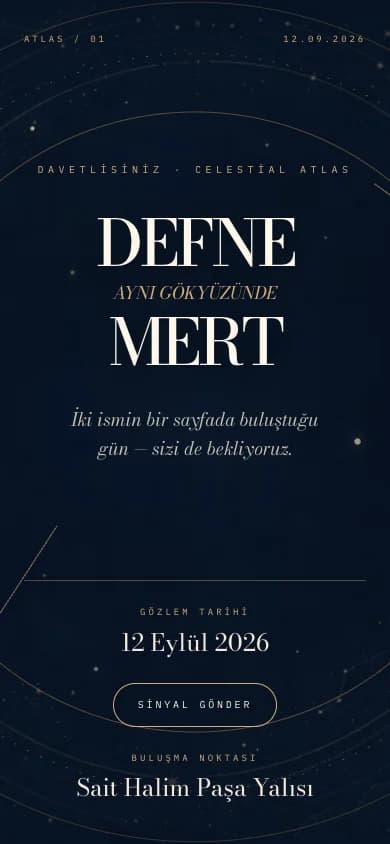
A scroll-driven invitation can show the schedule in a clean timeline, and a template such as Aurora or Blanc handles a multi-part day well.
Whose names go on a Turkish invitation?
Traditionally the invitation carries the couple's names, and often the parents' names too, because the wedding is seen as a union of two families. Several patterns are common:
- Couple only, for a modern, informal tone
- Couple with both sets of parents, for a traditional tone
- Parents inviting on behalf of the couple, which is the older, formal style
- A line such as "together with our families", which acknowledges the families without listing every name
If either family is sensitive about order, alphabetical or bride's side first are both acceptable. Ask the parents rather than guessing.
Tips for bilingual and mixed-culture couples
If you are marrying across cultures or languages, the invitation can include both without feeling crowded. The easiest approach is to write the main text in the language most guests read, then add a short second version below, or share two links.
Plan for different expectations. Some guests will come to every event, others only to the party. Say plainly what each event is, in a sentence, so guests unfamiliar with a kına or a nişan know what to expect and what to wear.
The davetvia interface and invitations can be set up in English, Turkish, Russian, Azerbaijani, Uzbek, Kazakh and Arabic, including right-to-left layout for Arabic, which is useful when the two families do not share a language.
Explaining a tradition in one line is a kindness to guests: "Kına gecesi is a traditional henna evening for the bride and her loved ones."
Sample lines for Turkish and bilingual invitations
Original phrases you can adapt. Mix in Turkish terms where they feel natural.
"Together with our families, we invite you to celebrate our wedding."
"With the blessings of our families, Elif and Can invite you to their wedding. Hayırlısıyla."
"Before the wedding comes the henna. Join us for our kına gecesi on the evening of 13 June."
"We are exchanging rings and we want you there. Nişan: 5 April, 15:00."
"Ceremony at 17:00, dinner and dancing to follow. Please arrive by 16:45."
"Kına gecesi is a traditional henna evening for the bride and the women of both families. All our loved ones are welcome."
Practical tips for the invitation itself
- Add a map link. Wedding halls in large cities can be hard to find, and valet or parking details save calls.
- State whether children are welcome and whether guests may bring a plus-one.
- Give the reply deadline and a way to answer. An online RSVP form means you receive guest numbers and notes in one place.
- If there is a dress code, say it in a sentence. Many guests will wear formal or semi-formal clothes, and the kına has its own conventions.
- Send it on WhatsApp. In Turkey, the invitation link is usually passed through family and friend groups, and you can follow it with a reminder.
See when to send wedding invitations for timing, or start with a template and preview your invitation free.
Digital invitations in Turkish weddings today
Printed cards remain popular, especially for older relatives, but digital invitations have become common. They suit a multi-event celebration, they reach guests abroad at no extra cost, and one change updates everyone.
For the full picture of what a davetvia invitation includes, see our digital wedding invitation page, or go straight to create your invitation.
Templates for this occasion
Open a live preview and personalise it in minutes.
Frequently asked questions
What is the difference between söz and nişan?
A söz is the formal family agreement, usually private, in which the families agree to the marriage. A nişan is the engagement ceremony, where rings are exchanged, often with a small party. Some families combine the two.
What is a kına gecesi?
A henna night, usually held the evening before the wedding. Henna is applied to the bride's palm, and family and friends sing and dance. It is a traditional pre-wedding celebration in Turkey and in many neighbouring cultures.
Do I need separate invitations for kına and the wedding?
You can use one invitation with separate events. Each event should show its own time and venue, so guests invited to only one of them see only what applies.
Should parents' names appear on the invitation?
It is a matter of family and style. Traditional invitations include them; modern ones often list only the couple, with a line like "together with our families".
How do we handle two languages on one invitation?
Write the main text in the language most guests read and add a short second version, or share two versions of the link. Keep the practical details, such as time and venue, identical in both.
Can a digital invitation include more than one event?
Yes. davetvia lets you add an engagement and a henna event to the wedding invitation, each with its own date, time and venue.